

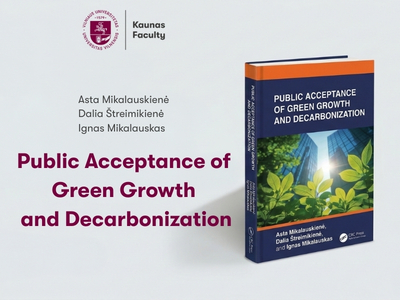
 The challenges of climate change, energy transformation, and the pursuit of a sustainable economy have become some of the most significant topics on political, economic, and social agendas. However, technological solutions and political strategies alone do not guarantee successful transformation. One essential factor enabling the transition to a climate-neutral economy is societal support and engagement. It is precisely this relevant and complex topic that is the focus of the monograph titled “Public Acceptance of Green Growth and Decarbonisation” by Professor Dr Asta Mikalauskienė, Senior Researcher Prof. Dr Dalia Štreimikienė, and Researcher Dr Ignas Mikalauskas from the Kaunas Faculty of Vilnius University.
Social Dimension of Sustainable Transformation
“In the monograph, we examine the importance of public opinion and participation in implementing green growth and decarbonisation processes,” explains Professor Dr Asta Mikalauskienė. The researcher’s studies include assessments of sustainability, the development of sustainable behaviour, and expressions of social responsibility. She is the author of numerous international scientific publications and actively contributes to the development of sustainability research. “The book provides a comprehensive theoretical analysis, empirical research, and practical examples that reveal how societal attitudes, values, and behaviour can accelerate or slow down the transition to a sustainable, low-carbon economy, as green growth transformation requires significant infrastructure changes, new consumption habits, and social solutions,” clarifies Prof. Dr Asta Mikalauskienė.
From Awareness to Trust: What Determines Public Support?
Co-author of the publication, Prof. Dr Dalia Štreimikienė, states that in recent years, more attention has been directed towards technological solutions – such as renewable energy, increased energy efficiency, and innovative climate policy measures.
“Practice shows that even the most advanced solutions can face societal resistance. Therefore, in our research, we chose to focus on social factors: public awareness, trust in institutions, perceived benefits or risks of technologies, cultural aspects, and social values,” comments one of Lithuania’s most well-known energy and sustainability researchers, author of over 200 scientific publications, Editor-in-Chief of the international scientific journal “Transformations in Business & Economics” (TIBE), and participant in numerous international projects, Prof. Dr Dalia Štreimikienė.
The publication systematically analyses how public attitudes towards green growth, renewable energy, and climate policy measures are shaped. It discusses key theoretical approaches, such as the technology acceptance model and innovation diffusion theory, that help explain the processes underlying societal opinion formation. It also examines factors influencing public support or opposition to sustainable initiatives.
A Complex Approach – An Important Value of the Book
“We integrate perspectives from economics, energy policy, environmental science, and social sciences,” explains Dr Ignas Mikalauskas, whose research areas include energy transformation, climate change mitigation, and public attitudes towards renewable energy. According to the scientist, such research is particularly significant: “In this manner, we create an interdisciplinary approach to one of the most important transformations of the 21st century – the transition to a sustainable and climate-neutral economy."
Dr Ignas Mikalauskas also notes that the book includes international case studies, allowing for comparisons of different countries’ experiences in implementing sustainable energy projects.
Empowering Society as the Foundation of Long-Term Green Transformation
In summary, the authors emphasise that informing, educating, and involving society are essential conditions for achieving long-term green transformation. Only through active public participation can we ensure that economic restructuring is not only technological but also socially acceptable.
The monograph is intended for researchers, doctoral candidates, students, energy and environmental policy specialists, and anyone interested in climate change mitigation, the green economy, and sustainable development. The monograph can be read at the Kaunas Faculty of Vilnius University Library. Those wishing to purchase the book can find it at the publisher Routledge’s online store.