

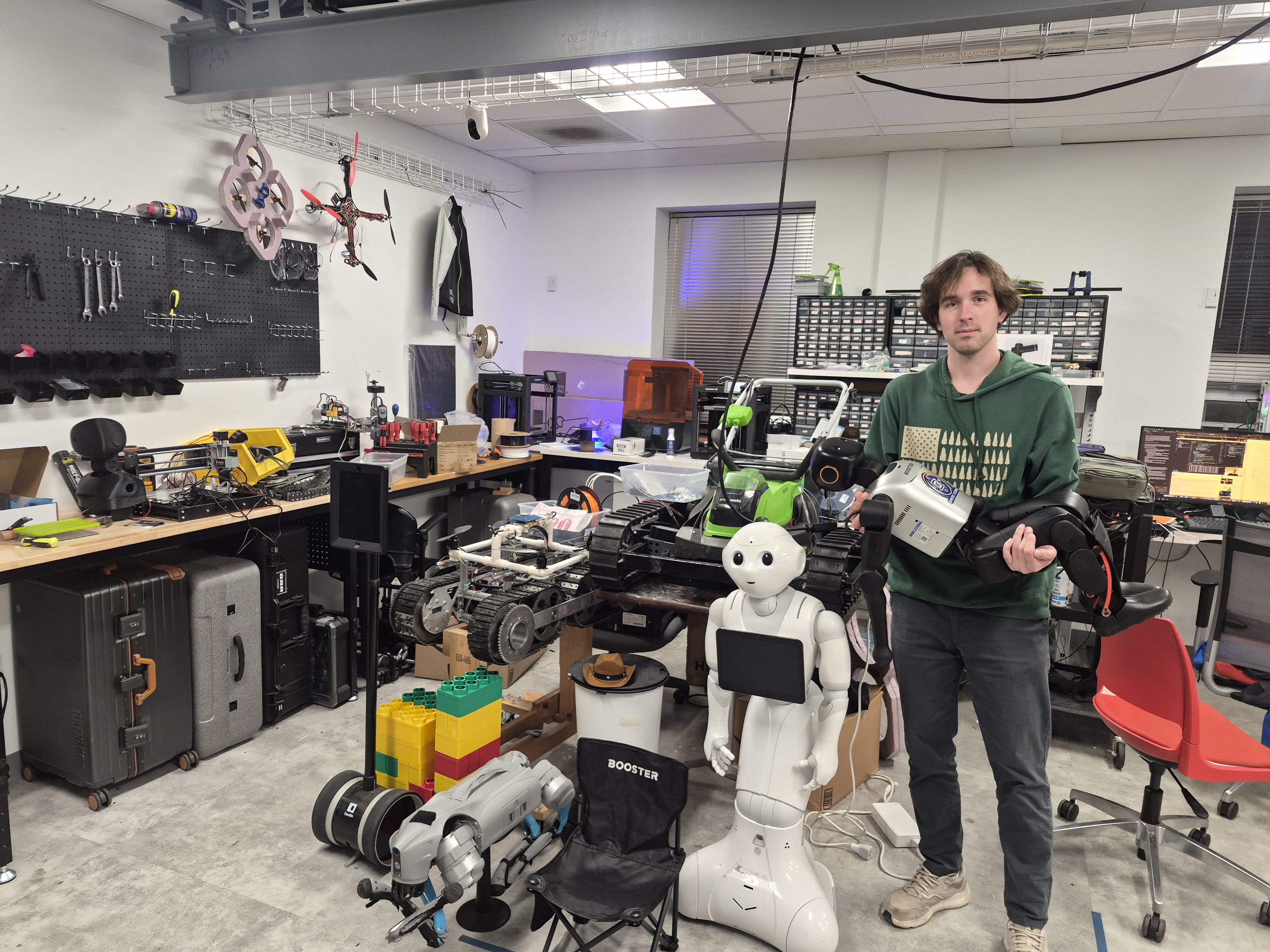
 Kyrylo Kolesnichenko, a fourth-year student in the Information Systems and Cyber Security bachelor's study program at the VU Kaunas Faculty, is applying his academic knowledge in an international research environment. He wanted to broaden his knowledge and take advantage of the international mobility opportunities offered by the Kaunas Faculty, so he spent part of his studies at universities abroad: the University of Tampere (Finland), the University of Vermont (U.S.), and Kent State University (U.S.). This experience allowed the student to gain a deeper understanding of robotics and to enhance his scientific expertise.
New Opportunities and the Discovery of Robotics
One of Kyrylo’s most significant academic experiences in the U.S. was a lecture titled “Software Development for Robotics” at Kent State University, led by Dr Jong-Hoon Kim, an associate professor of computer science and director of the Advanced Telerobotics Research Laboratory (“ATR Lab”). Intrigued by robotics, Kyrylo discussed with the professor the possibility of joining the lab he leads. Initially, he was offered the opportunity to collaborate with one of the lab’s doctoral students, and this successful experience encouraged him to continue this work. After the exchange semester ended, the student began a research internship at “ATR Lab,” which focuses on applying artificial intelligence to robotics, human-robot interaction, autonomous systems, and remote robot control. The laboratory’s interdisciplinary environment provided an opportunity to combine knowledge of software development, systems integration, and machine learning with practical work using robotic platforms. At the laboratory, the student contributed to various projects—ranging from human-robot interaction to research on robotic fashion and humanoid locomotion.
One of the main areas of his work has become training humanoid robots using reinforcement learning. This method allows robots to learn to choose actions based on the feedback they receive. Sometimes researchers take the robots out for a walk around the university campus or downtown to introduce them to the public. One of Kyrylo’s tasks was to transfer human movements from video recordings to the robots. He conducted experiments both in a simulation environment and using physical robot hardware. He is currently developing and training the motion model for the humanoid robot “Booster K1,” which is designed for the robot’s movements and demonstrations. These robots participated in a robot fashion show project in New York. The student showcases some of his completed projects on his personal website, www.kyry.me.
First Steps in Academia and the Path to an International Conference
His studies at the Kaunas Faculty of Vilnius University provided Kyrylo with a solid foundation in computer science and encouraged him to delve into more complex areas of technology. A key impetus came from the support of Dr Martas Ambraziūnas, a lecturer and associate professor at the Kaunas Faculty of Vilnius University: he encouraged the student to get involved in research and helped him prepare his first scientific publication. They presented this work at the international conference “Information Society and University Studies” (IVUS 2026) in a paper titled “Can Structured Prompting Overcome Knowledge Bias in Vision-Language Models?”.
Another important academic experience for Kyrylo was his participation in the international robotics and automation conference “IROS 2026.” There, the student, together with Assoc. Prof. Jong-Hoon Kim and PhD candidate Irvin Steve Cardenas, presented the study “Learning Expressive Humanoid Locomotion from Monocular Runway Videos for Robot Fashion Shows”.
The student says that the topics that interested him most at the conference were motion transfer, humanoid movement, and robot learning. Among the most memorable presentations, K. Kolesnichenko highlights the robot “Olaf,” created by Disney Research, and the California Institute of Technology (Caltech) project “Chasing Autonomy.” He also participated in events organised by “AGIBOT” and “PaXini,” where he established contacts with representatives of the robotics industry.
“By interacting directly with specialists from different fields, I realised what problems are currently being addressed in industrial companies and what skills are needed to contribute to progress in this field. It’s sometimes important for a researcher to step out of the lab and meet with practitioners,” the young researcher shares his impressions.
His research experience, collaboration with researchers, and participation in an international conference prompted K. Kolesnichenko to consider pursuing a further academic career and studying robotics at the master’s and doctoral levels.
“For those considering international opportunities or participation in research, I advise you to just go for it. Apply for exchange programs, talk to people and don't be afraid to try new things,” Kyrylo urges.