

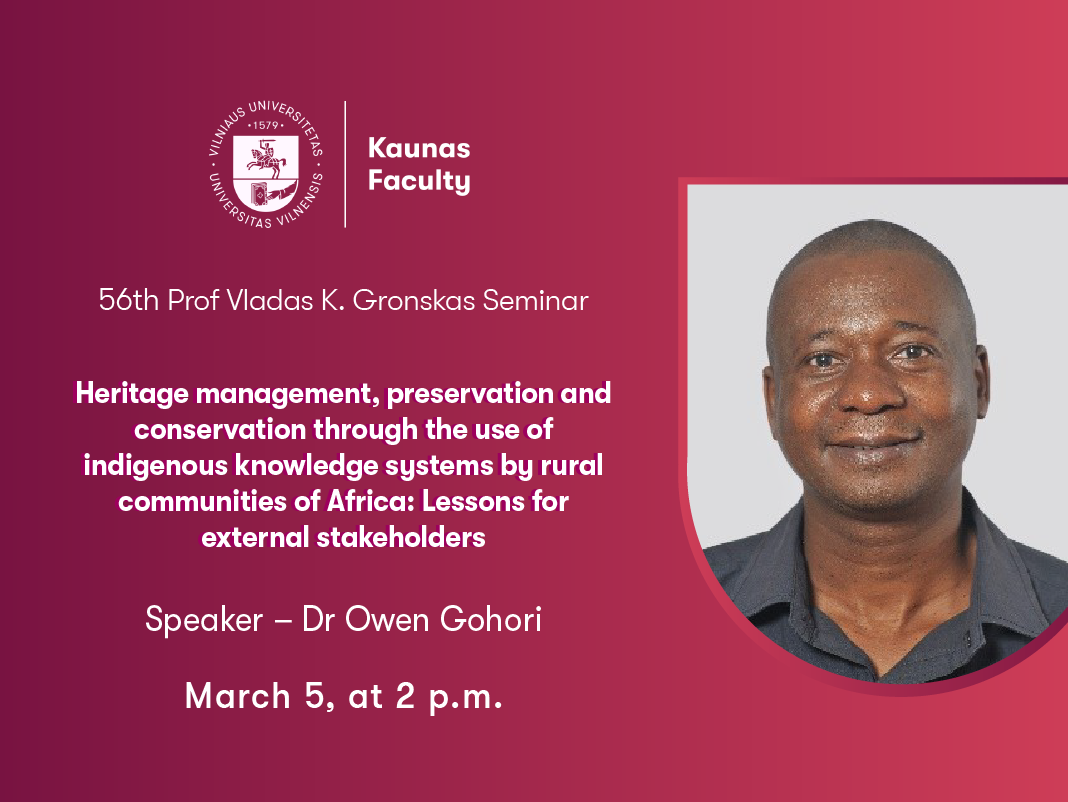
 The Institute of Social Sciences and Applied Informatics at the Kaunas Faculty of Vilnius University continues a series of seminars initiated by Professor Vladas K. Gronskas, now named in his honour, dedicated to analysing sustainable state development within a mixed economy.
The fifty-sixth seminar will take place at 14:00 on 5 March 2026 at Room No. 3 (III auditorija), Building No. 1 (Address: Muitinės Str. 8, Kaunas). Seminar Topic: “Heritage management, preservation and conservation through the use of indigenous knowledge systems by rural communities of Africa: lessons for external stakeholders”. Language of the presentation – English.
The seminar will discuss the use of African indigenous knowledge systems (IKS) and cultural/traditional practices that promote the management, preservation and conservation of heritage. Various African IKS principles and cultural practices, such as totemism, taboos, and sacred sites, will be assessed to determine whether they can be useful for the sustainable use, management, preservation and conservation of heritage.
About the speaker
Dr Owen Gohori is a Postdoctoral Fellow (ERA Fellow) researcher at the Institute of Social Sciences and Applied Informatics, Kaunas Faculty of Vilnius University, Lithuania. He holds a PhD in Tourism Management from the North-West University in South Africa. His PhD focused on the potential of tourism to alleviate poverty and bring about community development in rural communities of developing countries.
His interdisciplinary research encompasses sustainable development, community development, pro-poor tourism, heritage management, inclusive tourism, and the use and incorporation of indigenous knowledge systems in development projects and initiatives. Dr Gohori has presented at international conferences and published widely in high-impact journals. His current European Union-funded project aims to assess the potential of tourism social entrepreneurship to bring about sustainable community tourism development by utilising heritage in rural communities.
On behalf of the organisers
Prof. (HP) Dr Remigijus Čiegis