You Can Now Study Economics and Management in English at the Kaunas Faculty of Vilnius University

student vaizdin fotosesija webCurrent national and global trends show that economics and management studies can become a trampoline for a career, even to the highest positions. You do not have to look far for examples: Lithuanian President Gitanas Nausėda, serving his second term, is a doctor of social sciences and associate professor, but he first became known as an economist. The importance of specialists in this field to society is also highlighted by the list of the most influential Lithuanian economists and entrepreneurs that DELFI has published for the past 10 years. The top ten of 2024 is rounded off by another VU graduate – economist, Vilnius University lecturer, and associate professor Marius Dubnikovas. This trend further emphasises the importance of the Kaunas Faculty of Vilnius University study programmes in preparing future leaders. Therefore, there are no limits in this career field – the Kaunas Faculty of Vilnius University invites you to join the international market by offering Economics and Management studies in English. This direction opens up excellent opportunities for students who want to pursue both academic achievements and influential positions in business or government.

Economics and management – a combination of skills for decision-making

“Economics as a field of study is not so much a specialisation as it is an area of education that encourages a broad perspective and develops critical thinking and analytical skills, while management is a practical discipline applied in business,” says the scientist at the Institute of Social Sciences and Applied Informatics of the Kaunas Faculty of Vilnius University, Assoc. Prof. Rasa Pušinaitė-Gelgotė. According to her, economists with management skills will always have a competitive advantage in the labour market, as they can both analyse and manage.

The scientist at the Institute of Social Sciences and Applied Informatics of the Kaunas Faculty of Vilnius University, Assoc. Prof. Ilona Kiaušienė agrees with her colleague and says that knowledge of economics, analytical thinking, and the ability to make responsible management decisions are three components that significantly impact young people as they integrate into the labour market and plan their career prospects.

Read more: You Can Now Study Economics and Management in English at the Kaunas Faculty of Vilnius University

Get International student guide

Student_Guide_VU_KnFYour journey at Vilnius University BEGINS!

We are happy to welcome you to Vilnius University! In this international student guide, you will find all the important things to consider before arrival and at the beginning of studies, as well as some tips for an easier start. We hope that your time at Vilnius University becomes an unforgettable adventure!


Get Your  International Student Guide HERE


OPUS Proposed New Practices for Assessing Scientific Results Using Open Science Criteria

2025.08.07 OPUS team group photoOn August 25, 2025, an EU-funded project OPUS – Open and Universal Science (No. 101058471), whose main objective was to develop coordination and support measures to reform the assessment of research(ers), is nearing completion. The Kaunas Faculty of Vilnius University was one of the 18 partners in this project. The experience of project participants, especially organisations that have piloted various practices for evaluating scientific results using open science criteria, shows that open science dimensions can be integrated into the context of both research-performing and research-funding organisations.

Assoc. Prof. Aurelija Novelskaitė and Assoc. Prof. Raminta Pučėtaitė, the researchers implementing the project at the Kaunas Faculty of Vilnius University, had the task of offering pilot organisations indicators that would contribute to ensuring gender equality in science by implementing open science promotion processes. In practice, this was not easy, as each organisation had different gender equality and open science policies and implementation plans and differed in the specifics of their activities. Moreover, not all partners wanted to integrate these two areas, even though they are related.

Read more: OPUS Proposed New Practices for Assessing Scientific Results Using Open Science Criteria

Lithuanian Language and Culture Course for Foreigners Present Kaunas and Lithuania Through the Interaction of Transnationalism and Intercultural Dialogue

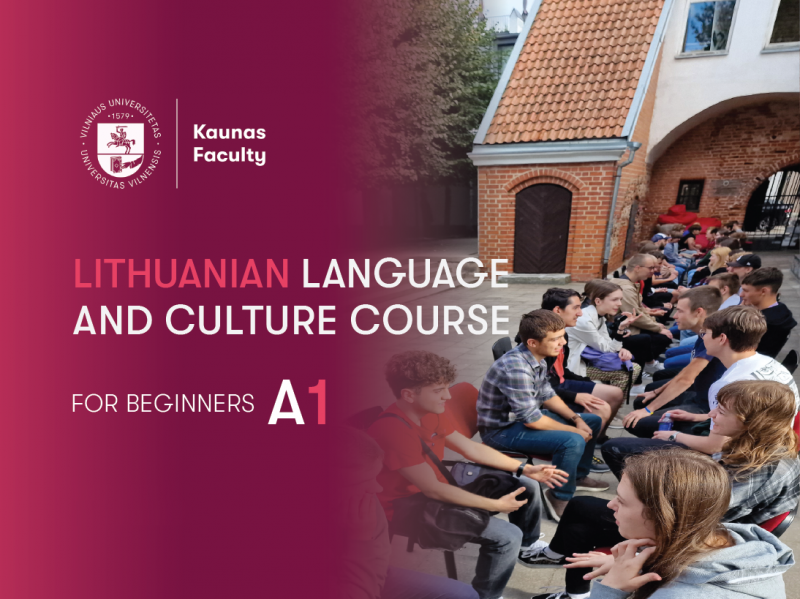
kursai13 webFrom 10 June to 9 July, the Kaunas Faculty of Vilnius University was hosting an intensive beginners' (A1 level) Lithuanian language and culture course. World Lithuanians, foreign university students, lecturers and scholars were invited to spend the first month of summer in Kaunas: to learn the Lithuanian language free of charge, to deepen their knowledge about the culture and history of Lithuania and Kaunas in particular, and to establish international contacts with participants from all over the world. This year, 10 participants from Brazil, Scotland, France, Italy and Georgia took part in the course.

The summer course at Kaunas Faculty started with the event "Taste the Language", during which foreign students gathered at the Faculty for the first time. They met the lecturers, introduced themselves and discussed the course programme. The climax of the event was a degustation of Lithuanian dishes. The degustation showcased Lithuanian culinary heritage, living traditions and the cuisine of Lithuania's ethnic minorities, whose dishes are popular and widespread throughout the country today.

Read more: Lithuanian Language and Culture Course for Foreigners Present Kaunas and Lithuania Through the...

Six PhD Students Begin Their Studies at the Kaunas Faculty of Vilnius University From September

From September 2025, six new PhD students will join the academic community of Kaunas Faculty of Vilnius University (VU KnF). They will carry out research in the fields of Humanities, Social Sciences, Natural Sciences and Technological Sciences. This reflects not only the diversity of the Faculty's scientific interests, but also its consistent commitment to promoting the advancement of science in both Lithuania and internationally. The new researchers will join the Faculty's high level of interdisciplinary research and active academic community.

Viltė Nausėdaitė, Humanities, Philology,
Giedrė Breiterė, Social Sciences, Management,
Eglė Grigaitytė, Social Sciences, Management,
Ivas Drungilas, Social Sciences, Economics,
Gintarė Košubienė, Natural Sciences, Informatics,
Oleksii Chalyi, Technological Sciences, Computing.

Read more: Six PhD Students Begin Their Studies at the Kaunas Faculty of Vilnius University From September

The VU Student Cap – an Authentic University Tradition

VU kepureleThe graduation season is just around the corner, when St Johns’ Church and other venues chosen for the official diploma-awarding ceremonies will be filled with the joyful bustle of graduates. As we approach this celebration, please be reminded that you are welcome to wear a VU cap during the ceremony.

‘The student cap is a special symbol for all students. It is a distinctive sign that allows us to identify with our Alma Mater even more and carry forward the spirit of studenthood with determination. By wearing the cap, we show that we are part of the Vilnius University community, which embraces and cherishes the University’s traditions and values,’ President of VU SA Klėja Merčaitytė said.

The end of the academic year celebration is an excellent opportunity to remember our academic roots and show our pride in the VU community. The cap distinguishes VU graduates from those of other higher education institutions and also helps maintain a uniform and recognisable style. Moreover, it is also a much more comfortable option for summer graduation ceremonies.

The VU cap is a symbol that reflects the academic spirit of VU, respect for knowledge, and community spirit. The cap was one of the most important signs of belonging to the academic community of the University, which the Jesuits founded in the 16th century. It reflected a student’s dedication to scholarship, the pursuit of knowledge, and respect for the University. These shared values have inspired the revival of the tradition of student caps today.

VU caps and other merchandise are available from the online shop and at the physical VU merchandise store at Šv. Jono g. 12, Vilnius (entrance from Pilies Street).

LMT Supports Student Participation in International Summer Schools

vu kauno fakulteto studentai 4x3The Research Council of Lithuania seeks to create favourable conditions for students of Lithuanian research and higher education institutions to become acquainted with the international academic environment that encourages student involvement in scientific research. At the same time, students are given the opportunity to present their academic interests, establish connections with international student communities and researchers, and foster international cooperation. To support this goal, the Council reimburses the expenses of students participating in summer school programmes abroad.

Eligibility – Bachelor’s and Master’s level students whose weighted average grade for all subjects taken in the most recent semester is not lower than 8.0 (on a 10-point scale).
At the time of application and throughout the summer school period, students must have a valid study agreement with Vilnius University.
Summer school period – The start and end dates of the summer school programmes are determined individually by the institutions organising the programmes. Therefore, they may not coincide with the summer holiday periods of Lithuanian or foreign higher education institutions.

Read more: LMT Supports Student Participation in International Summer Schools

51st Seminar of Prof Vladas K. Gronskas Invites to Discuss Assessment of Sustainable Agriculture with Dr Ahmad Bathaei

2025.07.03 Ahmad BathaeiVilnius University Kaunas Faculty, Institute of Social Sciences and Applied Informatics continues the series of seminars initiated by Professor Vladas K. Gronskas, dedicated to analyzing sustainable state development in the context of a mixed economy.

The fifty-first seminar will take place on June 3, 2025, at 13:00. The link to join the seminar online via Microsoft Teams online platform. Seminar Topic: Assessing Sustainable Agriculture in the EU/Baltic Countries Using Multi-Criteria Decision Making (MCDM) and EUROSTAT Data Using Stakeholder’s View.  Language of the presentation will be English.

The seminar will discuss the evaluation of sustainable agricultural development in the Baltic countries in the context of EU strategies such as the Green Deal and Common Agricultural Policy. We will explore how environmental, economic, and social indicators – such as soil health, water use, and biodiversity can be assessed using the TOPSIS method to support evidence-based policy and practice.

About the speaker

Dr Ahmad Bathaei is a researcher at the Lithuanian Center for Social Sciences, Institute of Economics and Rural Development. He holds two doctoral degrees: a PhD in Economics from the Lithuanian Center for Social Sciences and Vilnius Gediminas Technical University, focused on the economic assessment of agricultural sustainability in the Baltic States, and a PhD in Industrial Engineering from Universiti Teknologi Malaysia, with a specialization in agile and sustainable supply chains in the Iranian automotive industry.
His interdisciplinary research includes sustainable development, circular economy, supply chain resilience, and the application of multi-criteria decision-making (MCDM) methods. Dr. Bathaei has collaborated on international research projects and published widely in high-impact journals. His recent work explores the potential of digital transformation in enhancing circularity and sustainability in manufacturing and global supply chains.

On behalf of the organizers,

Prof. Habil. Dr Remigijus Čiegis