



The 14th International Conference on Culture and Creativity
Vilnius University
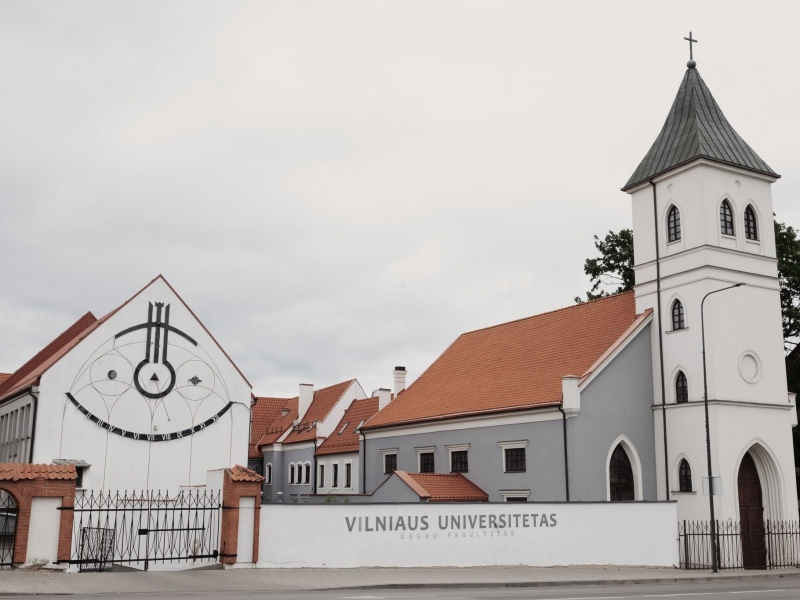
Kaunas Faculty
December 10, 2021
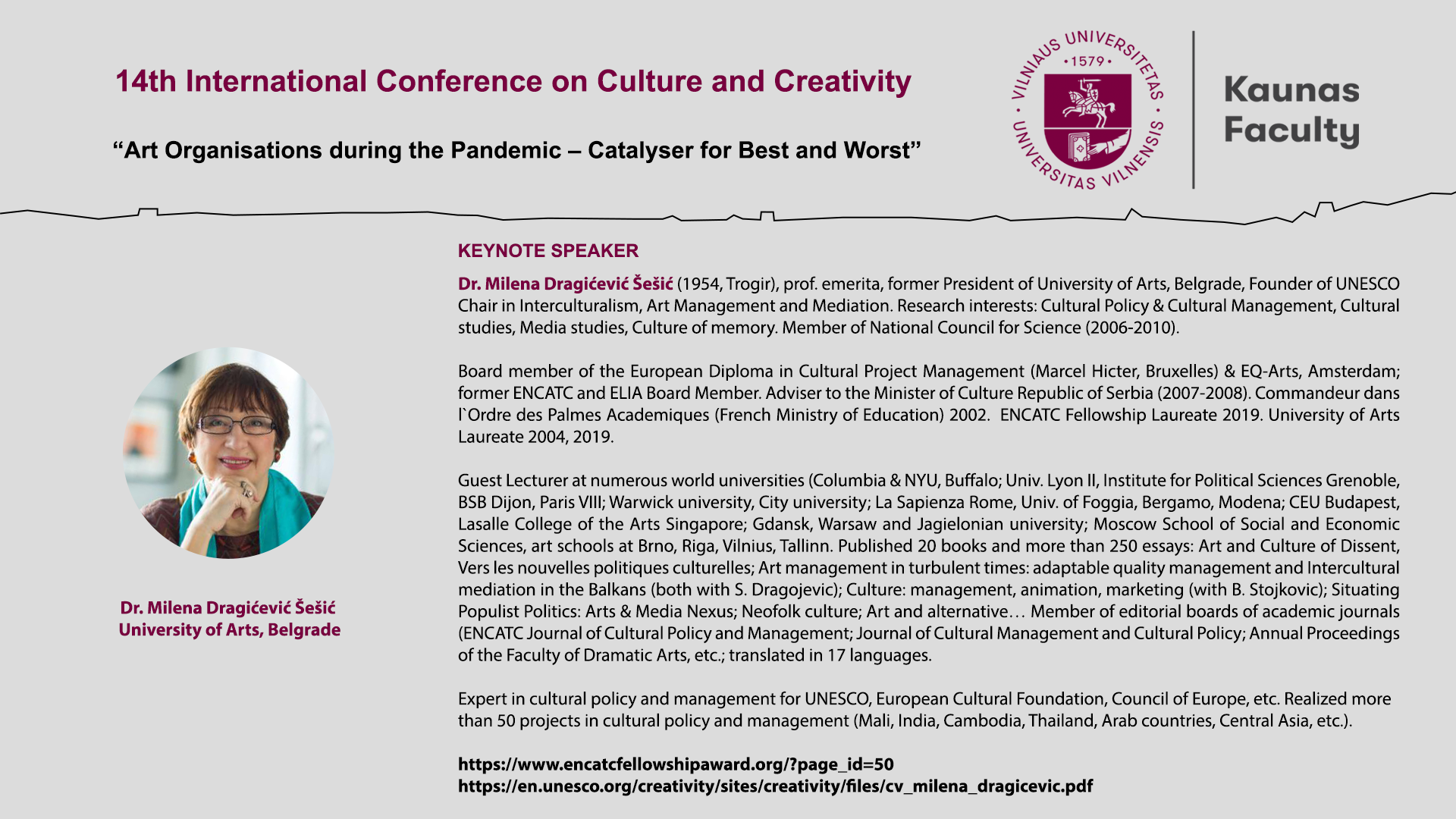
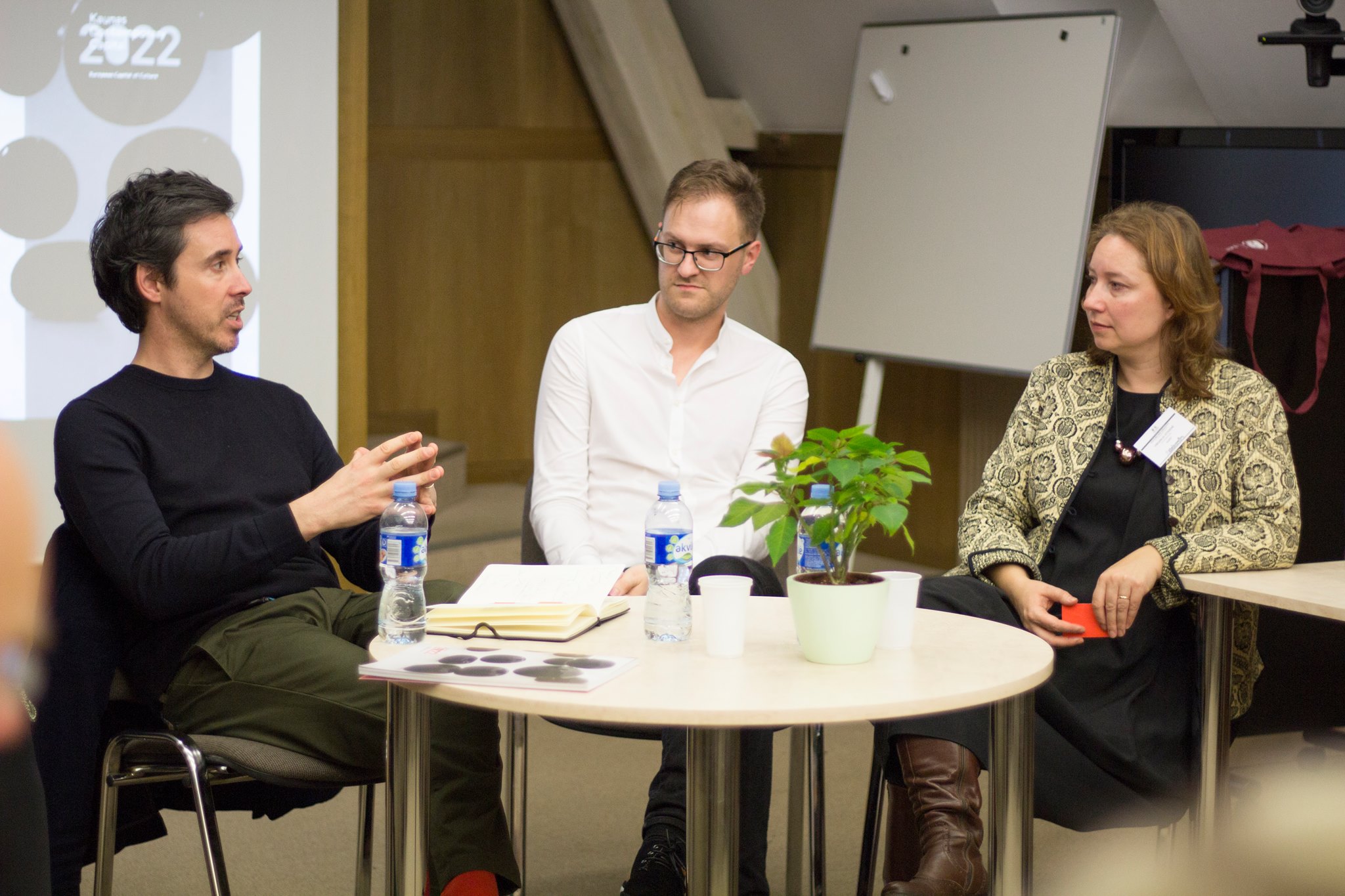
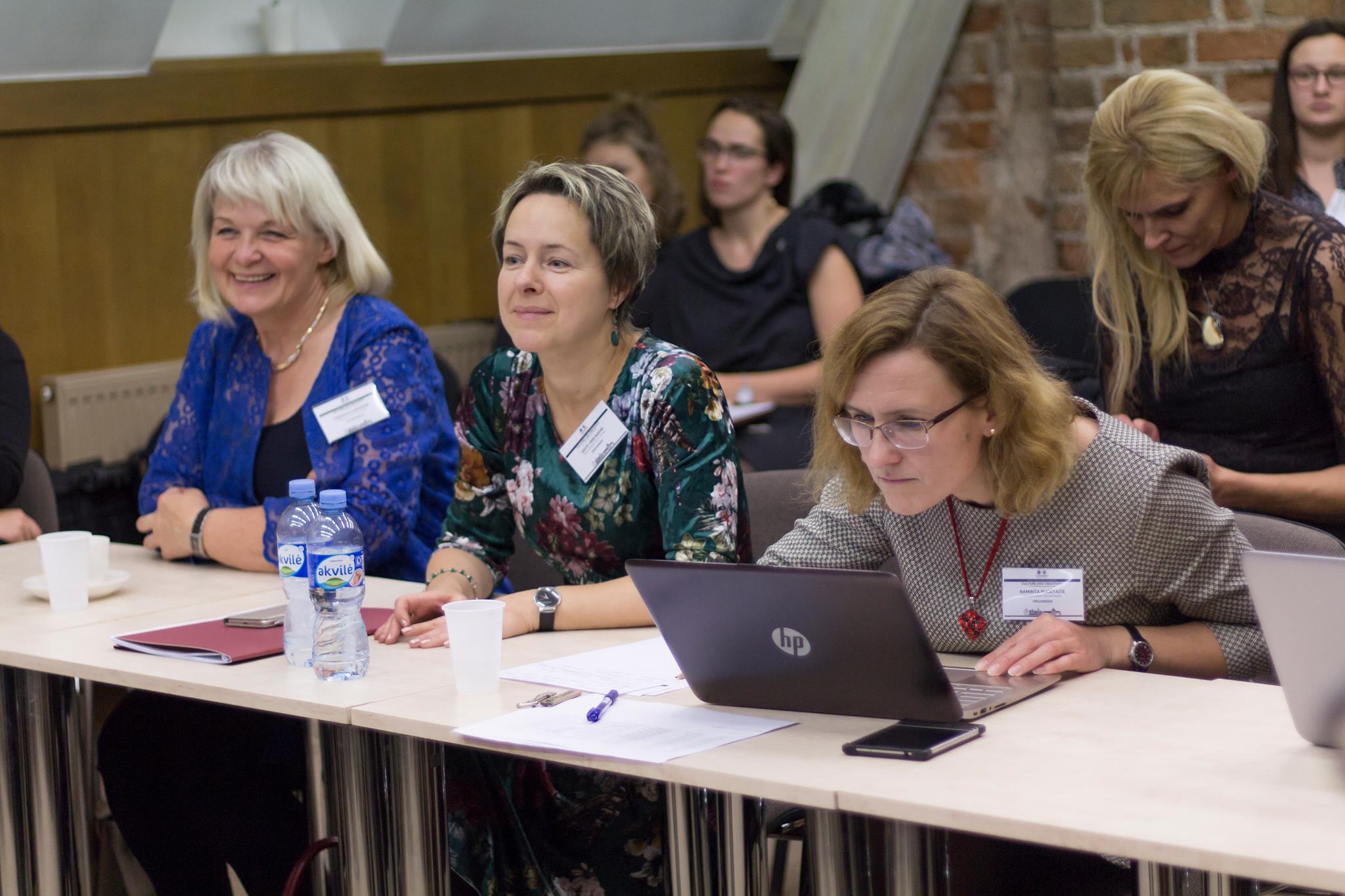
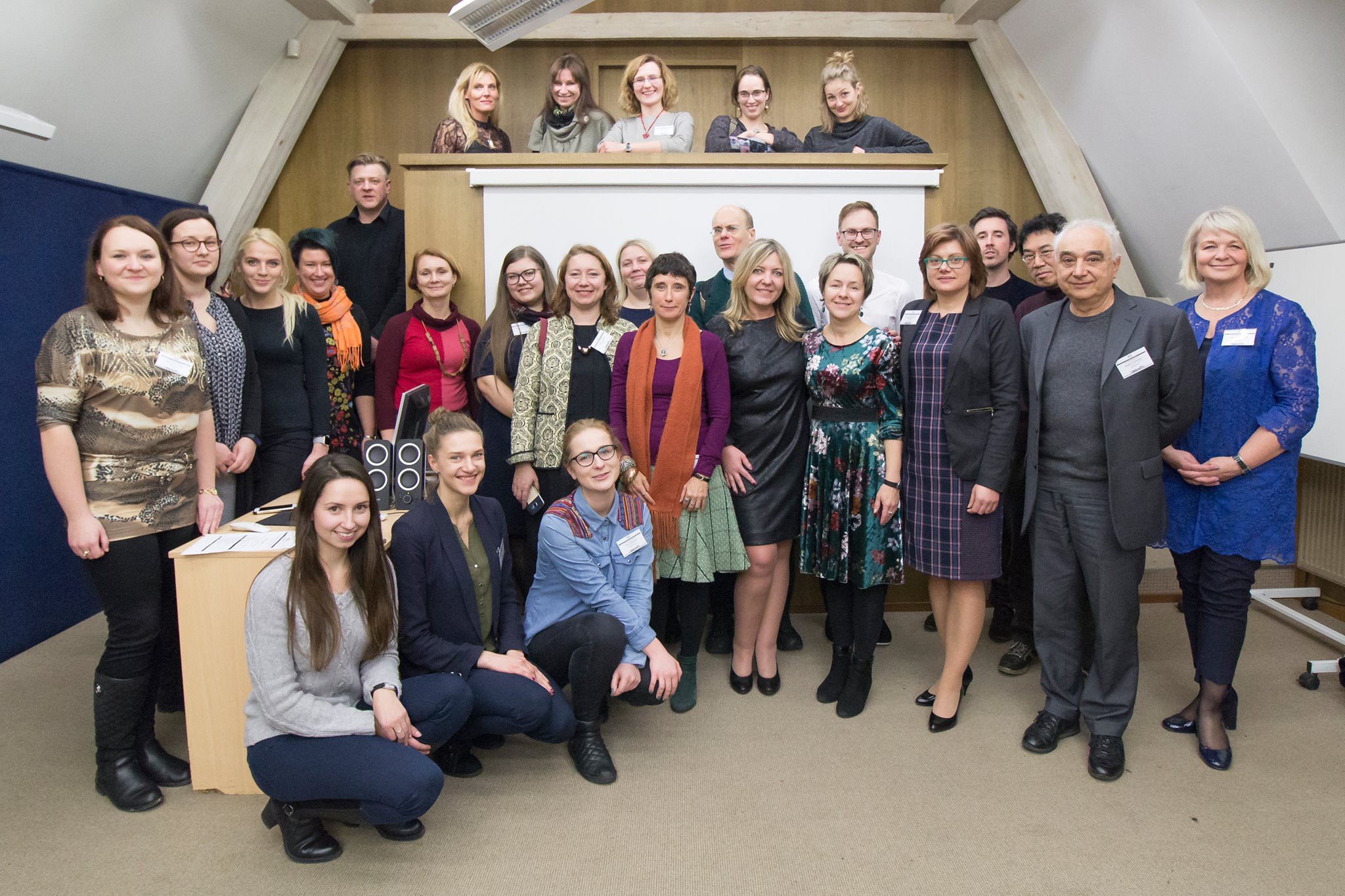
The 14th International Conference on Culture and Creativity invites scholars and professionals to discuss current trends and issues in cultural management and creative industries. The last two years have been particularly unfavourable for the cultural and creative sectors, as theatres, museums, concert halls and mass events were closed due to the pandemic and quarantine in many countries. Researchers and practitioners are invited to discuss the unprecedented experience of these two years, as well as the new insights, solutions, and innovations in creative business and public sector management. The conference welcomes all scholars and professionals interested in creative/cultural industries, creative business theories and practices, arts and culture management and marketing.
*The conference will be held remotely.
MAIN INFORMATION
The key dates:
10.11.2021 Submission of an abstract
15.11.2021 Notification regarding the abstract sent
19.11.2021 Submission of the full paper, registration, and payment of the conference fee
10.12.2021 The conference takes place
28.02.2022 Publishing of approved papers in electronic periodical issue Culture and Creativity, Vilnius University Open Series
A planned length of presentations is 15-20 min. followed by 10 min. discussions.
Conference language: English.
Selected conference papers approved by peer review will be published in the electronic periodical issue “Culture and Creativity”, Vilnius University Open Series
The best two papers selected by the Scientific Committee will be published in ISI Web of Science journal TRANSFORMATIONS IN BUSINESS & ECONOMICS
CONFERENCE TOPICS
- Current issues of cultural and creative industries management
- Contemporary challenges to cultural and creative organizations
- Self-management and self-organizing in creative industries during the pandemic
- Innovations in creative work organizing during the pandemic
- New marketing solutions for cultural and creative products
- Challenges to cultural tourism during the pandemic and their solutions
- Transformations in supply and value chains of creative industries
- Changes of political, economic, and legal environment of creative industries
- Gender issues in cultural and creative industries
The list of the main topics is not limited, presentations on related topics are also welcome..
CONTACTS
For all issues related to this conference, please contact:
Dovilė Balevičienė
Phone: +37067625255
REGISTRATION
Submission of an abstract until 10th of November, 2021(via Registration)
Notification regarding the abstract sent until 15th of November, 2021(via E-mail)
Submission of the full paper, registration, and payment of the conference fee until 19th of November, 2021* (via E-mail)
*Full paper should be sent by e-mail: , the subject of the letter: „ICCC: Full paper“, until 19th of November, 2021.
CONFERENCE FEE
|
Presenter fee (full price)* |
50€ |
|
Presenter fee (the member of Vilnius University community)* |
25€ |
|
Presenter fee (student)* |
15€ |
|
Participant fee (listener)* |
15€ |
*The fee includes participation in all sections, full conference documentation, conference material and a certificate.
Fee must be paid until 19th of November, 2021
Information related to fee payment:
Receiver: Vilniaus universitetas
Registered institution code: 211950810
VAT no: LT119508113
Address: Universiteto st.. 3, Vilnius, LT-01513, Lithuania
Bank: AB SEB BANKAS
Bank account no. LT247044060001101392
SWIFT code: CBVI LT 2X
Fee payment purpose: Name, Surname, KNF-2021-12-0008
IMPORTANT DATES
10.11.2021 Submission of an abstract
15.11.2021 Notification regarding the abstract sent
19.11.2021 Submission of the full paper, registration, and payment of the conference fee
10.12.2021 The conference takes place
28.02.2022 Publishing of approved papers in electronic periodical issue Culture and Creativity, Vilnius University Open Series
* Submission of papers is not a compulsory requirement. You may participate as a listener. However, you requested to submit your article, if you wish to present it during the conference, be selected and then have it published in the electronic periodical issue “Culture and Creativity”, Vilnius University Open Series. In such case, you are kindly reminded to register and submit your full paper until 19th of November, 2021 (Full paper should be sent by e-mail: , the subject of the letter: „ICCC: Full paper“)
PAPER SUBMISSION REQUIREMENTS
A copy of the scientific article should be forwarded to the following e-mail address: , the subject of the letter: „ICCC: Full paper“.
The authors of the manuscripts are expected to conform to the format and documentation requirements that are given below.
Guidelines for Authors
The reviewing process
All articles submitted for publication will be reviewed by at least two researchers appointed by the editorial board: one from the Editorial Board and one independent scientist of the language of origin - English. Reviewers stay anonymous.
Manuscript requirements
As a guide, articles should be between 6,000 and 10,000 words in length. In case the paper exceeds the normal length, the Editors' consent for its publication is needed. Articles should include the research aim and tasks, with detailed methodology, presenting literature overview on the research object, substantiation of the achieved results and findings, conclusions and a list of references, prepared after journal requirements.
Manuscripts should be arranged in the following order of presentation.
First page:
Title, subtitle (if any), autobiographical note (the author's full name, academic affiliation, telephone, fax and e-mail address and full international contact). Respective affiliations and addresses of co-authors should be clearly indicated. Please also include approximately 50 words of biographical information on each author of the submitted paper.
Second page:
(a) A self-contained abstract of up to 150 words, describing the research objective and its conclusions;
(b) up to five keywords, which encapsulate the principal subjects covered by the article;
(c) JEL classification, indexing all keywords according to the JEL classification system (please, refer to www.aeaweb.org/journal/jel_class_system.html); and
(d) a self-contained summary of up to 200 words, describing the article and its conclusions, suitable for translating into the Lithuanian language.
Subsequent pages:
Main body of the text with headings, footnotes, a list of references, appendices, tables, figures.
Technical presentation
Main body of the text should be printed in Times New Roman, 12pt with single line spacing. Footnotes should be numbered consecutively in Arabic numerals. Headings must be short, clearly defined and numbered, except for Introduction and Conclusions. All tables, figures are expected to back up your research findings. They should be clearly referred to and numbered consecutively in Arabic numerals. They should be placed in the text at the appropriate paragraph (just after its reference). All figures must have captions. In all figures taken or adapted from other sources, a brief note to that effect is obligatory, below the figure.
Keywords
Authors should also provide up to 5 keywords or descriptors that clearly describe the subject matter of the article. These terms have two purposes: firstly, to help describe the subject content of an article to prospective readers; and, secondly, to index the article for retrieval from a database or bibliography.
References
The ISI citations are a must for all contributors (please, refer to http://www.thomsonscientific.com/cgi-bin/jrnlst/jlresults.cgi?PC=MASTER ). References to other publications must be in Harvard style. That is, shown within the text as the first author's name followed by a comma, year of publication and the quoted page number - all in round brackets, e.g. (Doyle, 1994, p.23). If there are more than one author, the following format is used: (McAdam et al., 2001, p.236). At the end of the article a reference list in alphabetical order must be given as follows:
- For books: surname, initials, (year), title, place of publication, publisher. E.g. Ballou, R.H. (1992), Business Logistics Management, 3rd Edition, Eaglewood Cliffs: Prentice-Hall International Editions.
- For journals: surname, initials, (year), "title", journal, volume, number, pages. E.g. Fox, S. (1994), "Empowerment as a Catalyst for Change: an Example from the Food Industry", Supply Chain Management, Vol. 2, No 3, pp. 29-33.
- For Internet sources:Small Business Marketing Strategies: Marketing Research (YEAR), available at, http://www.marketingprinciples.com referred on 30/09/2002, Martin C.L. (1998), Relationship Marketing: a High-Involvement Product Attribute Approach, Journal of Product and Brand Management, Vol. 7, No 1, pp. 6-26 available at, http://www.apmforum.com/emerald/marketing-research-asia.htm, referred on 03/10/2002.
Copyright
Articles submitted to the journal should be authentic and original contributions and should have never been published before in full text, nor be under consideration for any other publication at the same time. Authors submitting articles for publication warrant that the work is not an infringement of any existing copyright and will indemnify the publisher against any breach of such warranty. For ease of dissemination and to ensure proper policing of use, papers and contributions become the legal copyright of the publisher unless otherwise agreed.
Proof
Authors are responsible for ensuring that all manuscripts (whether original or revised) are written in good English and accurately typed before final submission. One set of final editing will be sent to authors, if requested, before the final publication, which must be returned promptly
PUBLICATIONS
Selected conference papers approved by peer review will be published in the electronic periodical issue “Culture and Creativity”, Vilnius University Open Series
The best two papers selected by the Scientific Committee will be published in ISI Web of Science journal TRANSFORMATIONS IN BUSINESS & ECONOMICS
ORGANISERS
The conference is organized by Vilnius University Kaunas Faculty, Institute of Social Sciences and Applied Informatics, scientific group “Creative Industries and Innovations”.
Conference Scientific committee:
Conference chair person: prof. dr. Virginija Jurėnienė (Vilnius University, Lithuania)
Prof.dr. Vlado Dimovski ( University of Ljubljana, Slovenia)
Prof.dr. Dalia Štreimikienė (Vilnius University, Lithuania)
Assoc. prof. dr. Ann Werner (Södertörn university, Sweden)
Assoc. prof. dr. Audronė Rimkutė (Vilnius University, Lithuania)
Assoc. prof. dr. Aurelija Novelskaitė (Vilnius University, Lithuania)
Assoc. prof. dr. Ieva Zemite (Latvian Academy of Culture, Latvia)
Assoc. prof. dr. Mihalis Kavaratzis (University of Leceister, United Kingdom)
Dr. Baiba Tjarve (Latvian Academy of Culture, Latvia)
Dr. Jerlei Triin (Estonian Academy of Arts, Estonia)
Dr. Ilona Kunda (Latvian Academy of Culture, Latvia)
Dr. Ingrida Griesienė (Vilnius University, Lithuania)
Dr. Miglė Sarvutytė-Gailiūnienė (Vilnius University, Lithuania)
Conference organizing committee:
PHD candidate Ugnė Pavlovaitė (Vilnius University, Lithuania)
prof. dr. Virginija Jurėnienė (Vilnius University, Lithuania)
Assoc. prof. dr. Audronė Rimkutė (Vilnius University, Lithuania)
Dr. Ingrida Griesienė (Vilnius University, Lithuania)
Dr. Miglė Sarvutytė-Gailiūnienė (Vilnius University, Lithuania)
Dr. Dovilė Balevičienė (Vilnius University, Lithuania)



 Łukasz Bogucki
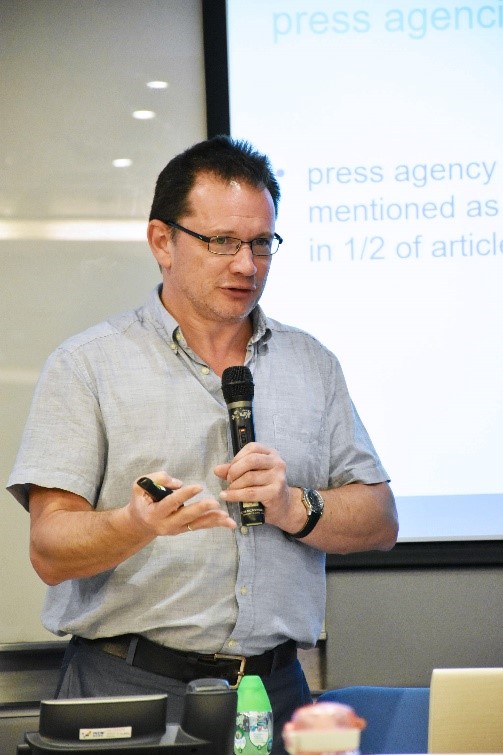 Luc van Doorslaer
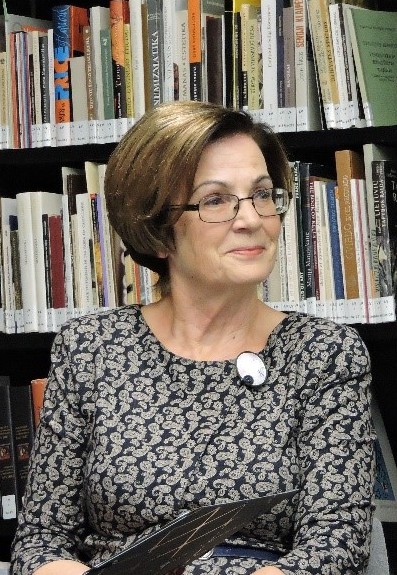 Danguolė Mikulėnienė
 Daiva Aliūkaitė