

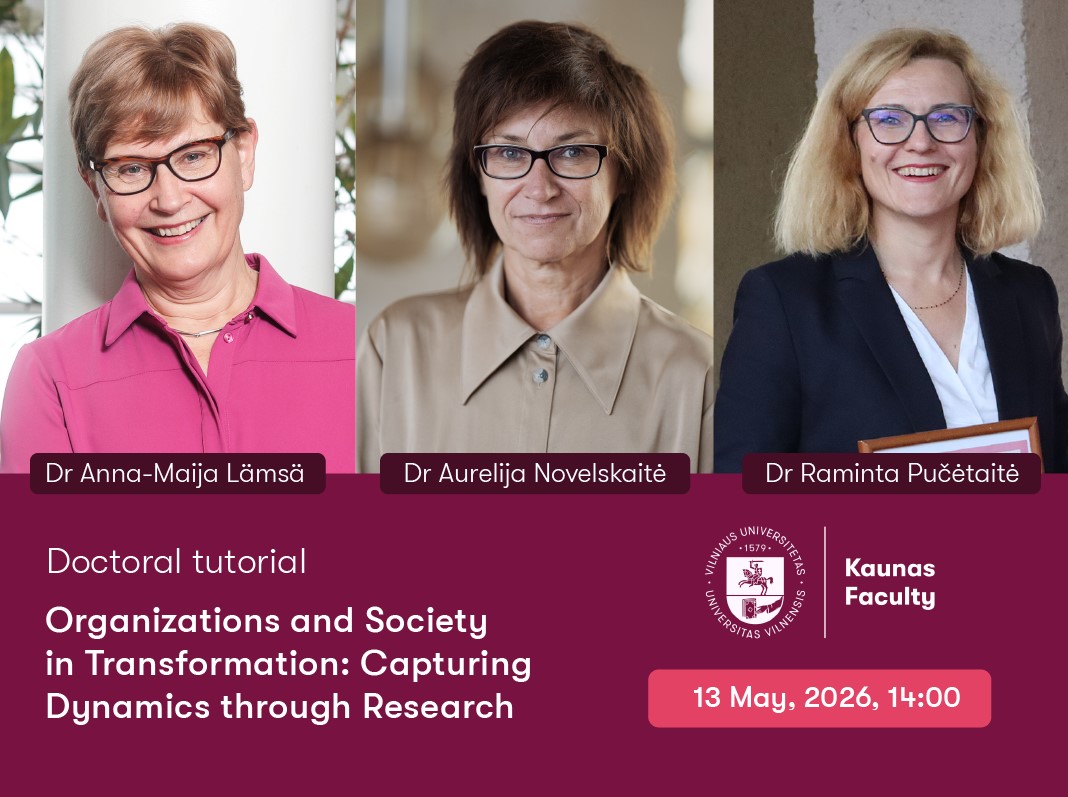
 The Doctoral tutorial is organized by the Research group ”Organizational ethics and social responsibility” of the Kaunas Faculty of Vilnius University.
Time: 13 May, 2026, 14:00-17:00
Place: Kaunas Faculty of Vilnius University, Muitinės Str. 8, Kaunas
Room: V auditorium
Supervisors:
Dr. Anna-Maija Lämsä, Professor Emerita at the University of Jyväskylä, Finland and Chief Researcher at Kaunas University of Technology, Lithuania
Dr. Aurelija Novelskaitė, Professor at Vilnius University, Head of the research group „Organizational ethics and social responsibility” at VU Kaunas Faculty
Dr. Raminta Pučėtaitė, Associate Professor at the Kaunas Faculty of Vilnius University, Professor and Head of Public Governance research group at Kaunas University of Technology
Announcement
Doctoral students in Management and Organizational Studies are invited to participate in a doctoral tutorial to progress their research.
During the Tutorial, you will work in a small group of four doctoral candidates and three supervisors. We hope this format will allow for in-depth discussion, constructive feedback, and a supportive learning experience.
Below you will find instructions on how to prepare so that you can benefit from the Tutorial as much as possible. We kindly ask you to follow the deadlines and instructions carefully, as this helps us ensure that everything runs smoothly for everyone involved.
We look forward to working with you.
To help you prepare for the Tutorial, please take note of the following steps:
Short paper: Prepare a paper (maximum 1000 words) for your thesis presentation using 12 pt Times New Roman, 1.5 line spacing. Please include your name and institution at the top left of the first page.
Kindly send the paper as an email attachment no later than April 10, 2026 to Raminta Pučėtaitė raminta.pucetaite @ knf.vu.lt. Selected participants will be informed by April 15, 2026. We plan to accommodate 4 doctoral students.
Peer paper: By April 30, you will receive the other candidates’ papers. Please read them carefully, as you will be asked to provide comments during the Tutorial. Further instructions are provided below.
PowerPoint presentation: Prepare a clear and well-structured PPT presentation and send it no later than Sunday, 10 May 2026, to Raminta Pučėtaitė, raminta.pucetaite @ knf.vu.lt.
Please see the instructions below.
Tutorial session: We look forward to seeing you at the Tutorial session on 13 May 2026. Please arrive on time.
Instructions for the Tutorial session
Every presentation and discussion has been reserved 45 minutes. Your presentation can last 15 minutes (maximum), preferably a bit less. 30 minutes (minimum) is reserved for discussion and feedback. Practice beforehand to keep the timetable.
PPT presentation
Prepare an informative PPT presentation including a maximum of 10 slides. The contents of the presentation can vary depending on the phase of the study and whether you want to present an article as part of the thesis or the whole thesis. From all participants, we ask you specifically to tell us that there is a need for new knowledge in your research field and to explain how you intend to fill that need and why: what is the focus of your dissertation, why is it of importance, how will your study advance knowledge, and within which specific area is your contribution located?
Send the presentation no later than Sunday, 10 May 2026, to Raminta Pučėtaitė raminta.pucetaite @ knf.vu.lt.
When you feel so, you will find a link here to help you prepare an informative PPT presentation.
Commentary
You will be allocated specifically one draft text by another candidate in your slot no later than Sunday, 10 March 2026. Prepare to present a 3-minute (maximum) commentary speech on this text. You may find the following checklist useful when preparing your commentary:
- Short summary (about 30 seconds): What is the study about? What seems to be its main contribution?
- Strengths (about 1 minute): Is that clear, convincing, or particularly interesting? What looks promising or innovative?
- Questions and suggestions (about 1–1.5 minutes): What would benefit from clarification or further development? Is the contribution to the field evident?
- Encouraging closing remark: End with a supportive comment that helps the author move forward.
We understand that your research process is ongoing, so some content-related aspects mentioned above may still be in development. One of the main aims of the Tutorial is to help you clarify these aspects. However, we kindly ask you to follow the given timetable punctually.